
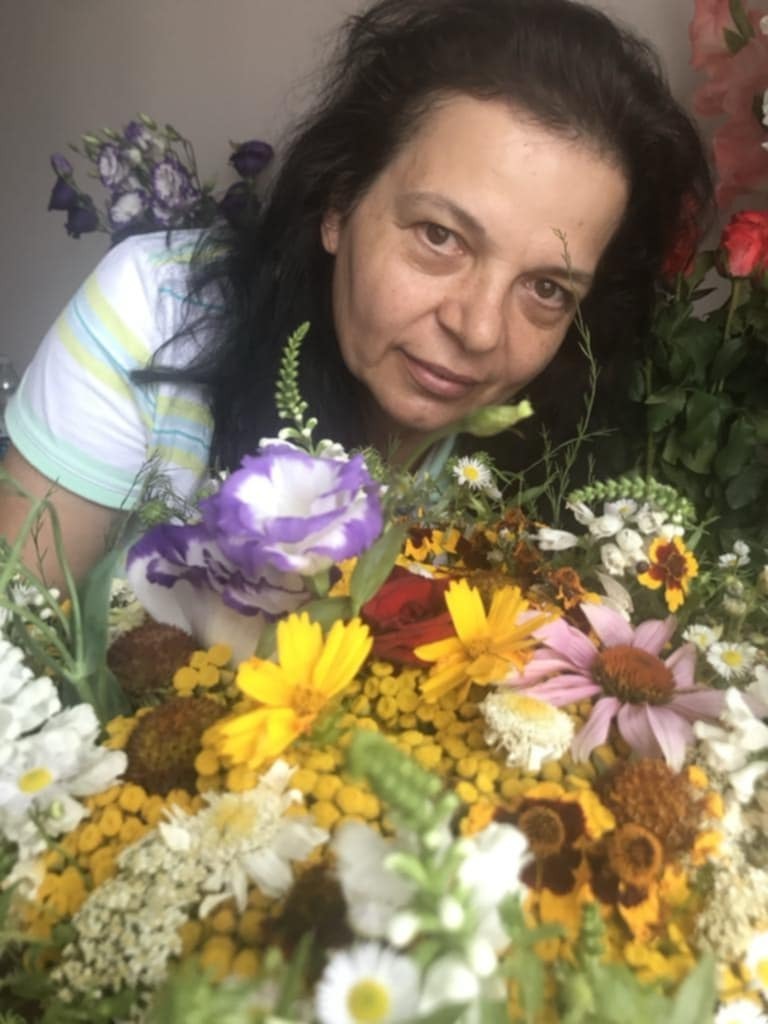
Dear reader, there is in this world at least one being who feels a deep need to lay bare her soul and her mind, to voice her revolts, sorrows and joys, to tell of what she has lived through, to laugh with others at other people’s follies — and at her own failures… There may well be more beings of this kind, but I know only one, and she unfortunately has no gift for speaking: I am talking about myself.
Never mind! Every problem has more than one solution. Mine is the written word. When I finish a poem or a story that I like and that I believe someone else might like too, for the feeling and the mood it carries, I feel as I do after doing something good for a person or for the society I live in. The books I have read were friends and mentors in my life; I hope my own books will matter to those who read them.
ELENA VIZIR, member of the Writers’ Union of the Republic of Moldova and of the Writers’ Union of Romania
Graduated from the Faculty of Philology of Chișinău State University, September 1980 – July 1985.
After a year as a Romanian teacher at a school in Chișinău (1985–1986), she worked as a proofreader and editor for a number of publishers and magazines in the Republic of Moldova: “Literatura Artistică”, “Hyperion”, “Făt-Frumos”, “Litera”, and the magazines “Limba Română”, “Țara”, “Cugetul”, “Gazeta Matematică”, “Viața Studențească”, “Spiridușii”.
In 2008 she became a member of the Writers’ Union of Moldova.
From 2008 to 2016 she worked as proofreader, editor and translator (from Russian into Romanian) with “Adevărul holding” (Romania), “Litera” (Romania) and “ROOSSA” (Moscow), translating a number of books from Russian.
From 2020 to 2023 she contributed to the children’s magazine “Spiridușii”.
Poetry: Libretto (“Prut Internațional”, Chișinău, 1999); Fantezii încremenite (“Prut Internațional”, Chișinău, 2007); Puncte dreptunghiulare (“Eikon”, Cluj, 2012); Orașul în care am respirat (“Prut”, 2021).
Prose: Dincolo de zâmbete (C’Arte, Paris, 2025).
Children’s books: A fost sau nu a fost vreodată (“Prut”, 2013); the series of verse tales and riddles De la pietre auzite: vol. 1 Un arici cârlionțat (2015), vol. 2 Cum ar fi să fii Horică (2016), vol. 3 Dirijorul de pisici (2017), vol. 4 Niște lebede-n pustiu (2019); the verse encyclopaedia 100 de răspunsuri captivante la 100 de întrebări savante (“Junimea”, Iași, 2025).
Translations from Russian: A. P. Chekhov — The Seagull, Uncle Vanya, The Cherry Orchard (“Adevărul holding”, Bucharest, 2010); N. V. Gogol — Taras Bulba, The Overcoat, The Nose, Viy (ibid., 2010); F. M. Dostoevsky — The Brothers Karamazov (ibid., 2011); The Preschooler’s Encyclopaedia and the series Activities for Clever Children (“Litera Internațional”, Bucharest, 2011); Treasures of European Museums, Treasures of Russian Museums, The Encyclopaedia of Wisdom (“ROOSSA”, Moscow, 2010), The Encyclopaedia of Historical Enigmas (ibid., 2011), The Great Preschooler’s Encyclopaedia (including two verse tales by V. A. Zhukovsky in her translation, as well as her own poems, tales, riddles, counting rhymes and lullabies — “ROOSSA”, Moscow, 2011); Vitaly Gubarev, The Kingdom of Crooked Mirrors (“ROOSSA”, Moscow, 2014), and others.
In anthologies: Vara visurilor mele (“Amurg sentimental”, 2013), Katharsis IV (“Arefeana”, Bucharest, 2013), Katharsis V (“Destine”, Bucharest, 2014), Enciclopedia scriitorilor români 2018 and Istoria literaturii române contemporane 2018 (“Verbaniana”, Craiova, 2018), Literatură pentru copii (“ARC”, Chișinău, 2018).
In literary magazines of Moldova and Romania: Tinerimea Moldovei, Literatura și Arta, Contrafort, Viața Basarabiei, Glasul Națiunii, Florile Dalbe, Limba Română, NOI, Farul Nistrean, Dor de Dor, Amurg sentimental, Omniscop, Expresia ideii, Cervantes.
Critical references: Andrei Langa, Liliana Armașu, Vitalie Răileanu, Grigore Chiper, Ion Ciocanu, Florin Grigoriu, Ion Machidon — pieces published between 2000 and 2016 in “Mesagerul”, “Țara”, “Biblio Polis”, “Contrafort”, “Dor de Dor”, “Viața Basarabiei”, “Amurg sentimental”.
2011 — First prize in the VELOTECA competition for the best children’s story on the theme “An adventure with a bicycle” (the story Tomorrow I Will Be a Champion);
2021 — Special prize at the Senior Scriitor competition “Romanians and Romania through the eyes of the elders”;
2024 — First prize of excellence at the 5th Festival of Arts for The Story of a Village of Idlers (French version).
With this volume Elena Vizir offers a genuine treasury of scientific knowledge cast in an accessible and deeply educational literary form. It is a collection of didactic poems answering the great questions of childhood and of human curiosity in general — from how a rainbow forms and why earthquakes happen to the life of plants and the intelligence of insects.
The book impresses with its elegant blend of scientific rigour and poetic play. Written in classical, rhymed and rhythmic verse, the poems turn complex notions (the greenhouse effect, pollination, photosynthesis) into vivid images that readers of any age can remember.
It covers a wide range of fields: geography, physics, biology, astronomy, ecology, chemistry and even technology. The answers rest on accurate scientific facts, often accompanied by explanatory notes and historical curiosities — from Newton and Pliny the Elder to modern scientists.
Elena Vizir does more than inform: she cultivates ecological and humanistic awareness. Some texts take the tone of an ethical warning about humanity’s relationship with nature — climate change, pollution, deforestation, the protection of wildlife.
Written above all for children and teenagers, the book will appeal to adults too. The language is clear and expressive, rich in rhymes and accessible metaphors; the verses brim with imagination, fine humour and inspired wordplay.
It is more than a book of poems: a manual of popular science, an original educational undertaking and a plea for curiosity, responsibility and love of nature. Recommended reading for school, library and home alike.
This author’s books will appear in our shop soon. See all books